How to Safely Use AI Assistants for Aesthetic Clinic Patient Enquiries
AI Assistants For Aesthetic Clinics · Automating Patient Website Questions · How to design and build an AI assistant for your website
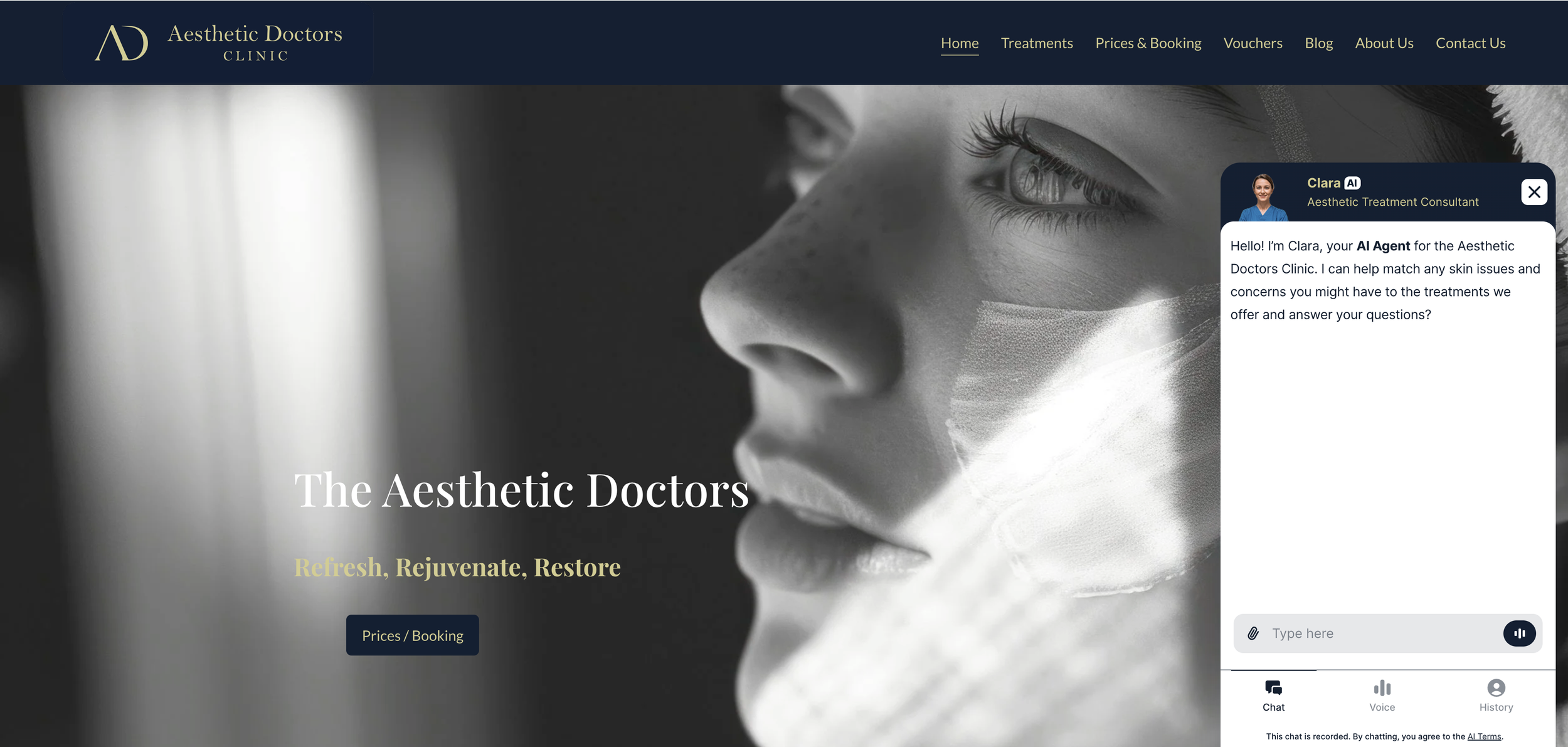
AI assistants are moving into aesthetic clinic reception desks faster than almost any other technology in recent memory. The promise is straightforward: faster response times, 24/7 enquiry capture, fewer missed leads, and less admin pressure on the team. The reality is slightly more complicated, particularly for clinics operating in the UK and Ireland.
Used well, an AI assistant for patient enquiries can be a genuinely useful tool. Used carelessly, it can breach GDPR, fall foul of UK CAP and Irish ASAI advertising rules, give unsafe clinical information, and leave the clinic exposed. This guide covers what aesthetic clinics can safely delegate to AI, what they cannot, and how to build a workflow that keeps both patients and the clinic protected.
Compliance note This guide refers to UK GDPR, the Data Protection Act 2018, ASA/CAP guidance, HPRA rules in Ireland, and the EU AI Act. Regulatory requirements are subject to change. Clinics should seek independent legal or compliance advice for their specific circumstances and not rely solely on general guidance.
Why Aesthetic Clinics Are Using AI Assistants
Aesthetic clinics face a specific operational challenge: enquiries arrive across multiple channels simultaneously. Instagram DMs, WhatsApp messages, website contact forms, and phone calls all arrive at the same time, often outside business hours, and many ask the same handful of questions. Without an automated layer, those enquiries sit unanswered until a receptionist arrives in the morning, and a proportion of them have booked elsewhere by then.
AI assistants, configured correctly, can capture those enquiries in real time, provide approved general answers, book consultation slots, and route anything more complex to the clinical team. Healthcare chatbots have demonstrated value in appointment scheduling and routine information tasks, though the clinical evidence base for wider AI chatbot use in healthcare is still developing, and human oversight remains essential throughout.
For aesthetic clinics specifically, the gains are practical: faster first response, consistent messaging, reduced repetitive admin, better pre-consultation routing, and a cleaner enquiry-to-booking journey. The caution is equally practical: aesthetic clinics handle health-related data, discuss prescription-only medicines, and owe a duty of care to vulnerable patients. An AI assistant that is not properly configured can undermine all three.
What AI Assistants Can Safely Handle
The safest AI use cases in an aesthetic clinic are those that involve general, non-clinical information and administrative logistics. Used within these boundaries, an AI assistant for patient enquiries reduces admin load without clinical risk.
• Opening hours, location, parking, and accessibility information.
• Appointment availability and consultation booking.
• Rescheduling and cancellation policy.
• General treatment category information that does not recommend specific treatments or medicines.
• Sending approved pre-consultation forms and questionnaires.
• Explaining what happens at a consultation in general terms.
• Collecting non-sensitive administrative information such as name, preferred contact, and reason for enquiry.
• Routing enquiries to the right team member or department.
• Sending approved aftercare reminders written and signed off by qualified clinicians.
• Directing patients to contact the clinic directly for any clinical concern.
What AI Assistants Should Not Do
This is the section that matters most for patient safety and regulatory compliance. AI assistants in an aesthetic clinic setting should not, under any circumstances, do the following:
• Diagnose skin conditions, reactions, or complications.
• Decide whether a patient is suitable for any treatment.
• Prescribe or recommend prescription-only medicines.
• Give personalised medical advice of any kind.
• Tell a patient they are safe to proceed with treatment.
• Replace or shortcut the informed consent process.
• Handle urgent or adverse symptom reports without immediate escalation.
• Promise or imply treatment results.
• Use pressure-selling or urgency language around bookings.
• Promote prescription-only medicines to the public, including botulinum toxin and similar injectables.
• Ask for detailed medical history in an open, unsecured chat interface.
• Store sensitive data without documented controls and a clear lawful basis.
• Send final clinical replies to patients without a qualified human reviewing them first.
The UK and Ireland Compliance Basics
Data Protection and Health Data
Patient enquiries can become health data faster than most clinic owners realise. A message that starts as a booking request can quickly include information such as a history of autoimmune disease, a current pregnancy, or a previous reaction to treatment. In UK and EU law, health data is special category data, requiring both an Article 6 lawful basis and a separate Article 9 condition for processing, alongside clear documentation.
For clinics using AI assistants to handle enquiries, the practical requirements include:
• A clear, accessible privacy notice presented before or at the very start of any AI chat interaction.
• Data minimisation: collecting only what is genuinely needed at that stage.
• A documented lawful basis for processing each category of data collected.
• A special category condition where health-related information is involved.
• A Data Protection Impact Assessment for higher-risk AI workflows, which most aesthetic clinic AI chatbot deployments would qualify as.
• A signed data processor agreement with the AI vendor.
• No patient-identifiable information entered into general consumer AI tools such as ChatGPT, Gemini, or similar products, unless those tools have been assessed and data processing terms confirmed.
• Clear data retention and deletion policies.
• Access controls and audit logs covering AI interactions.
The ICO in the UK and the Data Protection Commission in Ireland are both clear that GDPR applies to automated processing of personal data. If the AI chatbot collects or processes personal data, GDPR obligations apply. Health-related data carries additional requirements, and clinics should ensure their vendor agreements and internal policies reflect this.
Advertising Rules for Botulinum Toxin and Prescription-Only Medicines
Compliance note In the UK, CAP guidance states that prescription-only medicines may not be advertised to the public. In Ireland, the HPRA takes the same position. AI assistants must be configured to route enquiries about these treatments to a consultation, not to recommend or promote them.
This is one of the most important areas for aesthetic clinics, and one where AI assistants create a specific risk if not properly restricted.
In the UK, CAP guidance is clear that prescription-only medicines may not be advertised to the public. The ASA has specifically addressed botulinum toxin products in this context: clinics should promote the consultation, not the prescription-only medicine itself. In Ireland, the HPRA takes the same position: prescription-only medicines may not be advertised or promoted to the public across any media channel, including online and automated messaging.
The risk with an unconfigured AI assistant is that it may respond to an enquiry about anti-wrinkle treatments in a way that crosses the line into advertising a prescription-only medicine, for example by naming the product, confirming it is available, or implying that the patient is a suitable candidate before clinical assessment has taken place.
The safe approach is straightforward: configure the AI to route all prescription-only medicine enquiries to a consultation. It can say the clinic offers a range of treatments for concerns such as lines, facial volume, and excessive sweating, and that a consultation is required with an appropriately qualified prescriber. It should not name prescription-only medicines, confirm their availability, or recommend them.
Human Review and Automated Decisions
UK guidance on automated decision-making sets out that individuals have rights in relation to automated decisions that significantly affect them, including the right to human intervention, to express their point of view, and to challenge a decision. In the aesthetic clinic context, a decision about treatment suitability would fall within this category.
Ireland sits within the EU AI Act environment. The EU AI Act entered into force on 1 August 2024 and becomes fully applicable from 2 August 2026, with staged exceptions for different system types. AI systems used in healthcare contexts will need to be considered under this framework as obligations come into force.
The safest model is not one where AI decides. It is one where AI supports, and a qualified human decides. AI can draft, collect, remind, and route. A qualified clinician should assess, advise, obtain informed consent, prescribe, treat, and manage complications.
A Safe AI Workflow for Aesthetic Clinic Enquiries
A well-designed workflow limits AI to the tasks it can handle safely and ensures human review at every point where clinical or compliance risk is present. The following step-by-step sequence applies to most aesthetic clinic AI assistant implementations:
1. Patient starts an enquiry via website chat, WhatsApp, Instagram DM, email, or a phone transcript tool.
2. AI immediately provides a short, clear disclosure: "I'm an automated assistant helping the clinic respond to enquiries. For clinical concerns, please contact the clinic directly."
3. AI answers only from an approved, clinician-reviewed knowledge base covering general and administrative questions.
4. AI avoids any diagnosis, treatment suitability assessment, or promotion of prescription-only medicines.
5. AI collects minimum necessary details only: name, preferred contact, general reason for enquiry.
6. AI flags clinical or urgent keywords, including complication terms, vulnerability indicators, and any prescription-only medicine requests, and routes these immediately to the human team.
7. Human team reviews all flagged messages before responding, with a qualified clinician involved for anything clinical.
8. Clinician handles all matters involving medical suitability, risk discussion, informed consent, prescribing, and post-treatment complications.
9. All conversations are logged securely, with access controls and retention policies in place.
10. Clinic reviews AI outputs regularly, updates the knowledge base when policies or regulations change, and monitors for errors or drift.
Red-Flag Enquiries AI Must Escalate Immediately
Any AI assistant used in an aesthetic clinic must be configured to recognise and immediately escalate the following types of enquiry to a qualified human:
• Severe pain, especially following a recent procedure.
• Vision changes, visual disturbance, or eye-related symptoms following injectable treatment.
• Skin blanching, discolouration, or vascular compromise.
• Signs of infection: increased redness, heat, swelling, or discharge.
• Difficulty breathing or swallowing.
• Allergic reaction symptoms of any kind.
• Pregnancy, breastfeeding, or questions about treatment during pregnancy.
• Under-18 enquiries or any indication the patient may be a minor.
• Body dysmorphia indicators or signs of psychological vulnerability.
• Medical history involving blood thinners, autoimmune conditions, allergies, or previous treatment complications.
• Complaints, refund requests, or any language suggesting a legal or regulatory concern.
• Any request for a prescription-only medicine by name or by implication.
This list is not exhaustive. The general principle is: if there is any doubt, escalate. An AI assistant that escalates too cautiously is far preferable to one that handles something it should not.
Example Patient Questions and Safe AI Responses
The following examples show how a well-configured AI assistant handles common enquiry types. Each illustrates the same principle: be genuinely helpful with general information, route clinical decisions to a qualified human, and keep the door to a consultation open.
Compliance note: These are illustrative examples only. All AI response templates should be written and approved by a qualified clinician before use in your clinic.
Patient: What treatments can address acne scarring?
Treatment category enquiry
| "Great question, and one we hear a lot. Several approaches can help improve the appearance of acne scarring, including skin resurfacing treatments, microneedling, and chemical peels, depending on the type and depth of scarring. The right option depends on your skin type, scar type, and medical history, which is why we always start with a consultation. Our practitioners can assess your skin in person and recommend the most appropriate approach for you. Would you like to book a consultation?" |
Why this works: The AI describes treatment categories without recommending a specific treatment or implying suitability. It routes to a consultation and avoids outcome claims.
Patient: How much does lip filler cost?
Pricing enquiry
| "Our treatment pricing depends on the amount of product used and the treatment plan agreed at consultation. We do not publish a single fixed price for lip treatments because our practitioners tailor every plan to the individual. The best way to get accurate pricing for your goals is to book a consultation, which gives you a full assessment and a clear picture of what is involved and what it costs. Would you like me to check availability for you?" |
Why this works: Pricing for dermal fillers should not be advertised in a way that promotes the treatment without reference to consultation. This response is accurate, helpful, and compliant with current guidance on filler advertising.
Patient: Can I have anti-wrinkle injections if I'm breastfeeding?
Medical suitability question — must escalate
| "Thank you for asking before booking. This is exactly the kind of question that needs to be answered by one of our qualified practitioners rather than through this chat. Please contact the clinic directly on [phone number] or email [address] so a member of the clinical team can advise you properly. We would not want to give you anything other than accurate, personalised guidance on this." |
"Why this works: Any question about contraindications, medical history, or clinical suitability must go directly to a qualified clinician. The AI escalates clearly without making the patient feel dismissed.
Patient: I had filler two days ago, and one side looks bigger than the other. Is that normal?
Possible post-treatment concern — immediate escalation
| "Thank you for getting in touch. Any concerns after treatment need to be reviewed by the clinical team rather than through this chat. Please contact the clinic directly now on [phone number]. If you are experiencing pain, skin colour changes, vision changes, or feel unwell in any way, please seek urgent medical help immediately or call 999. The team will want to hear from you as soon as possible." |
Why this works: Post-treatment concerns are always a clinical matter. The AI responds with urgency, provides the right escalation route, and includes emergency guidance.
Patient: Do you do Botox?
Prescription-only medicine enquiry by brand name
| "We offer a range of injectable treatments for concerns such as lines, wrinkles, and facial movement, all carried out by qualified prescribers following a full consultation. I am not able to confirm or recommend specific prescription treatments through this chat, but I can book you in for a consultation where a practitioner can assess your concerns and explain the options available to you. Would that be helpful?" |
Why this works: Botulinum toxin is a prescription-only medicine and cannot be advertised to the public by name. The AI avoids naming the product, routes to a consultation, and stays compliant with ASA/CAP and HPRA guidance.
Patient: I'm 16 and want to get my lips done. Can I book?
Under-18 enquiry
| "All aesthetic treatments and consultations at this clinic are available to adults aged 18 and over only. We are not able to book aesthetic treatments for anyone under 18. If you have a parent or guardian who would like to contact the clinic on your behalf for general information, they are welcome to get in touch directly on [phone number]." |
Why this works: Under-18 enquiries must be declined clearly and without ambiguity. The AI does not soften the refusal or suggest workarounds.
Patient: Can you just tell me whether I'm suitable for treatment? I don't want to book a consultation yet.
Request to bypass consultation
| "I completely understand, and I wish I could give you a straight answer here. The reason we always ask people to come in for a consultation is that suitability depends on your medical history, skin type, and individual goals, things that can only be assessed properly in person by a qualified practitioner. It is not a sales step; it is a clinical one. The consultation itself is a good conversation, not a commitment. If it would help, I can book you in at a time that suits you, and you are under no obligation to proceed with anything." |
Why this works: The AI explains the clinical reason for a consultation clearly and warmly, without pressuring the patient or implying suitability can be assessed remotely.
Vendor Checklist: Choosing an AI Assistant for Your Clinic
Not all AI chatbot products are suitable for use in an aesthetic clinic setting. Before selecting and implementing any AI assistant for patient enquiries, clinics should work through the following questions with the vendor:
• Does the vendor sign a Data Processing Agreement before any data is processed?
• Where is patient data stored, and in which country or region?
• Is patient data used to train or improve the underlying model?
• Can patient data be deleted on request, within required timeframes?
• Are access controls available to limit who can view conversation logs?
• Are full audit logs available and exportable?
• Can the clinic create and control an approved answer template library?
• Can the AI be restricted from giving clinical advice or recommending treatments?
• Can it detect and escalate red-flag terms automatically?
• Can it integrate with clinic booking software without over-collecting personal data?
• Does it support human review before sensitive or clinical replies are sent?
• Can it handle subject access requests and data deletion requests efficiently?
• Does it provide analytics and reporting without relying on over-collection of personal information?
Best-Practice Rules for Clinic Teams
Technology is only part of the picture. The team using and managing the AI assistant is equally important. The following principles should be embedded in clinic policy and reinforced through regular training:
• Use only an approved, clinician-reviewed knowledge base to populate AI responses. No improvised or unreviewed content.
• Keep all AI answers general, factual, and non-promotional. Nothing the AI says should read as an advertisement for a specific treatment or medicine.
• The AI must identify itself as an automated assistant at the start of every conversation.
• Under no circumstances should the AI make clinical decisions, assess suitability, or manage treatment complications.
• Anything medical, urgent, emotionally distressed, or complaint-related must be escalated to a human immediately.
• Review conversation transcripts regularly to catch errors, escalation failures, or tone issues.
• Train reception, marketing, and clinical staff on what the AI can and cannot do, and how to manage escalated conversations.
• Keep a record of all changes made to prompts, templates, and knowledge base content, including the date and who approved the change.
• Update AI content promptly whenever clinic policies, treatment protocols, or regulatory requirements change.
KPIs to Track When Using AI for Patient Enquiries
Implementing an AI assistant should improve measurable outcomes for the clinic. The following metrics provide a clear picture of whether it is working as intended:
• First response time: how quickly enquiries receive an initial reply.
• Enquiry-to-consultation conversion rate: whether AI-handled enquiries convert at a comparable rate to human-handled ones.
• Missed enquiry reduction: fewer unanswered messages at the start of the working day.
• No-show rate: whether pre-consultation AI reminders reduce appointment non-attendance.
• Number of escalated conversations: how many enquiries the AI correctly routes to a human.
• Escalation accuracy: whether the AI is escalating the right types of enquiry.
• Human override rate: how often staff intervene to correct or replace an AI response.
• Patient satisfaction scores: whether the AI interaction experience is rated positively.
• Complaint volume: tracking whether AI-related misunderstandings are generating complaints.
• Data deletion and access request handling time: a compliance metric that should be part of every AI implementation review.
• AI error rate: the frequency with which the AI produces an incorrect, incomplete, or non-compliant response.
The Takeaway
The most useful AI assistant for an aesthetic clinic is not the one that answers everything. It is the one that knows exactly what it should and should not do, and hands the conversation to a qualified human the moment it reaches the limits of what is safe.
AI can reduce admin pressure, improve response speed, and help clinics capture enquiries they would previously have missed. It cannot replace clinical judgement, it cannot manage complications, and it cannot make decisions that require a qualified prescriber or practitioner. Clinics that build these boundaries clearly into their AI setup, and review them regularly, are the ones that will benefit from the technology without the regulatory and reputational risk.
The safest AI assistant for an aesthetic clinic is not the one that answers everything. It is the one that knows when to stop, when to escalate, and when to let a qualified human take over.
Ready to build a website that works harder for your clinic?
Websites for Clinics builds SEO-ready websites for aesthetic clinics across Ireland and the UK, with built-in local SEO structure, schema markup, location pages, and content written specifically for the aesthetic sector.

-
Yes, but AI should be limited to general information, booking support, approved FAQs, and enquiry routing. It should not diagnose conditions, assess treatment suitability, prescribe or recommend prescription-only medicines, or manage complications without qualified human review at every stage.
-
Not unless the clinic has fully assessed the tool against GDPR requirements, confirmed data processing terms with the provider, evaluated privacy risks, and documented retention settings. Patient-identifiable information should not be entered into general consumer AI tools without this assessment in place.
-
It can route the enquiry to a consultation, but it should not promote prescription-only medicines to the public, confirm treatment suitability, recommend specific treatments, or imply a prescription assessment is unnecessary. ASA/CAP guidance in the UK and HPRA guidance in Ireland are clear on this point.
-
Only if the content is pre-approved by the clinic's clinical team and includes clear escalation instructions. Any enquiry involving worrying post-treatment symptoms should be routed immediately to a qualified clinician, and the patient should be directed to seek urgent care if appropriate.
-
Yes. Aesthetic clinics should be transparent with patients about when they are interacting with an automated system. The AI should identify itself at the start of every conversation and make it easy for the patient to reach a human.
-
Yes. If the chatbot collects or processes personal data, GDPR and UK GDPR obligations apply. Where health-related information is involved, additional requirements for special category data processing may also apply, including the need for a Data Protection Impact Assessment.
-
Yes. Ireland is an EU member state, and AI systems used or supplied in the Irish market will need to be considered under the EU AI Act as its obligations come into full force from 2 August 2026. Clinics should begin familiarising themselves with the framework and the obligations that may apply to their AI systems.