A No brAIner for Aesthetic Clinics: Practical AI Tools That Save Time, Improve Efficiency and Unlock Revenue
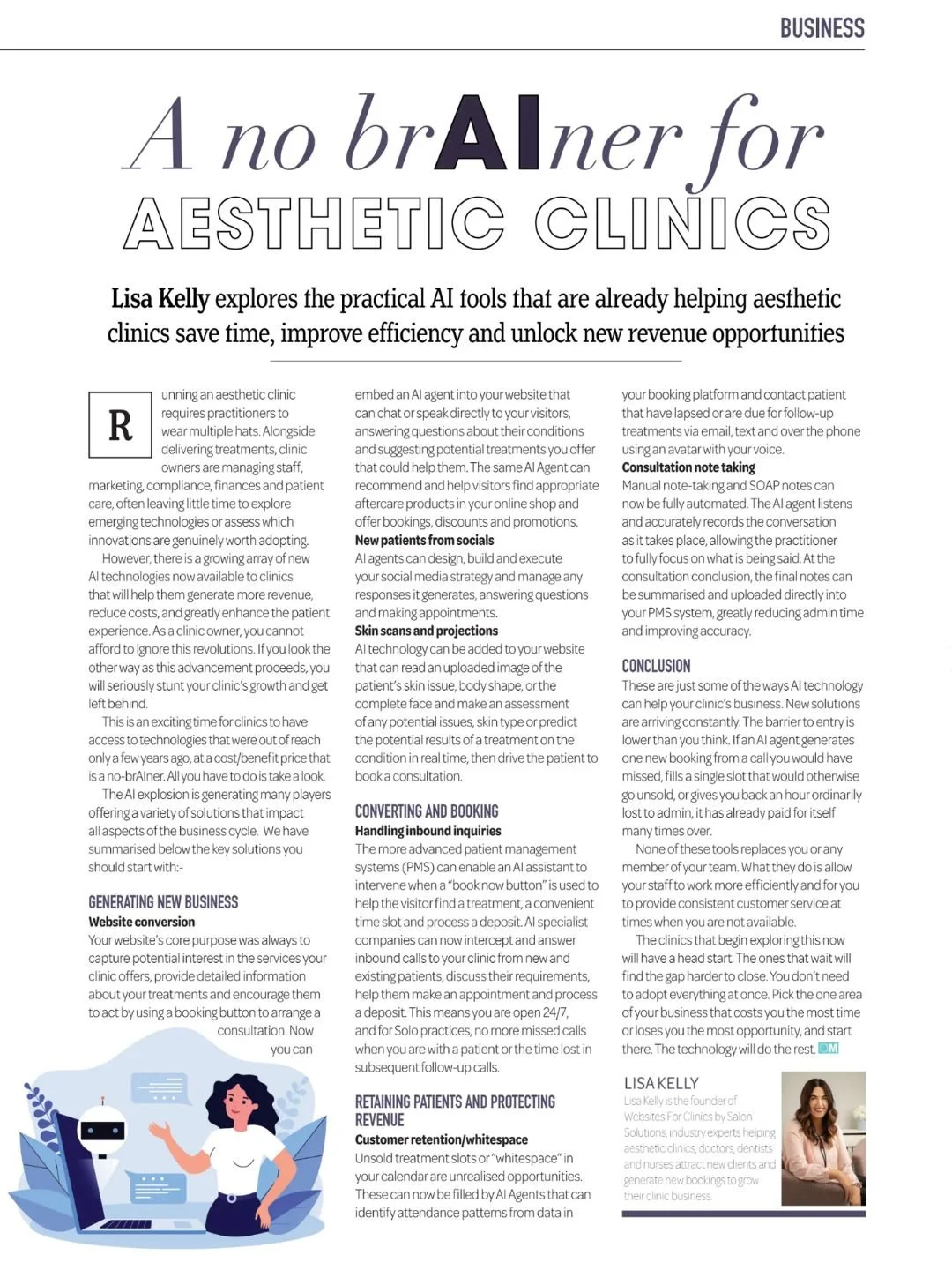
For the July/August 2026 issue of Aesthetic Medicine, we turn our attention to the AI explosion — and what it actually means for the clinic owners on the ground running the appointments, the admin, and everything in between. Running an aesthetic clinic means wearing multiple hats — treatments, staff, marketing, compliance, finances, and patient care — and that rarely leaves time to explore emerging technology or work out what's genuinely worth adopting. Author Lisa Kelly makes the case that this is exactly the moment clinics can't afford to look the other way.
In this edition, we break down the practical AI tools already helping aesthetic clinics across Ireland and the UK generate more revenue, reduce costs, and improve the patient experience — without needing a tech background to make sense of any of it. From website AI agents that convert visitors into consultations, to AI-powered inbox handling for the diary gaps you didn't know you had, this is a grounded look at where to start and why the cost-to-benefit is a no-brAIner.
This issue provides a practical roadmap through the AI tools clinics should start with:
Website Conversion: How an AI agent embedded on your website can chat or speak directly with visitors, answer questions about their conditions, recommend suitable treatments and aftercare products, and encourage bookings around the clock.
New Patients From Socials: Using AI agents to design, build, and execute your social media strategy, manage responses, answer enquiries, and turn engagement into actual appointments.
Skin Scans and Projections: How AI can read an uploaded image of a patient's skin or body, assess potential treatment needs, and predict likely results in real time — before they've even booked a consultation.
Handling Inbound Enquiries: Why more advanced patient management systems can now let an AI assistant intervene the moment a "book now" button is used — finding the right treatment, securing a time slot, and taking a deposit, so no call goes unanswered and no booking is lost to a missed moment.
Retaining Patients and Protecting Revenue: How AI Agents can identify attendance patterns and unsold "whitespace" in your diary, then reach out to lapsed or overdue patients by email, text, or phone using a natural-sounding voice — filling slots that would otherwise go unsold.
Consultation Note Taking: How AI can now fully automate manual note-taking and SOAP notes — listening to the consultation, recording it accurately, and uploading a summary directly into your PMS system — freeing the practitioner to focus entirely on the patient in front of them.
None of these tools replace you or your team. What they do is let your staff work more efficiently and let your clinic offer consistent service at the hours you can't physically be available. If an AI agent generates one new booking you'd otherwise have missed, fills a slot that would have gone unsold, or gives you back an hour ordinarily lost to admin — it has already paid for itself many times over.
The clinics that begin exploring this now will have a head start. The ones that wait will find the gap harder to close. You don't need to adopt everything at once. Pick the one area of your business that costs you the most time or loses you the most opportunity, and start there. The technology will do the rest.
As published Aesthetic Medicine Magazine : https://mag.aestheticmed.co.uk/articles/296808?article=59-1