How to Get Your Aesthetic Clinic to Appear in AI Search Summaries
Rank in Google AI Overviews & voice search · Build authority, trust, and visibility · Attract high-value clients organically
What Are AI Search Results — and Why Clinics Must Adapt
Search has changed — and the numbers make the scale of that change hard to ignore. Google processes over 8.5 billion searches every day, and AI-generated answers now appear at the top of results for a growing proportion of them. According to data from BrightEdge, generative search SEO (SGE, AI Overviews) features are already present in around 84% of search queries in the US, with UK and Irish adoption following closely. For health and beauty queries specifically — exactly the searches your prospective clients are making — AI Overviews appear consistently and prominently. What this means in plain terms is straightforward: a summary answer generated by Google's AI now sits above the organic listings your clinic has spent time and money trying to rank in. If your clinic is not being cited in that summary, a significant portion of your potential clients will find their answer, and possibly their practitioner, without ever seeing your website.
Free Checklist
Use the button below to download our free checklist. As you read this blog, check the steps against your website and see what steps you need to take to get your aesthetic clinic to appear in AI summaries
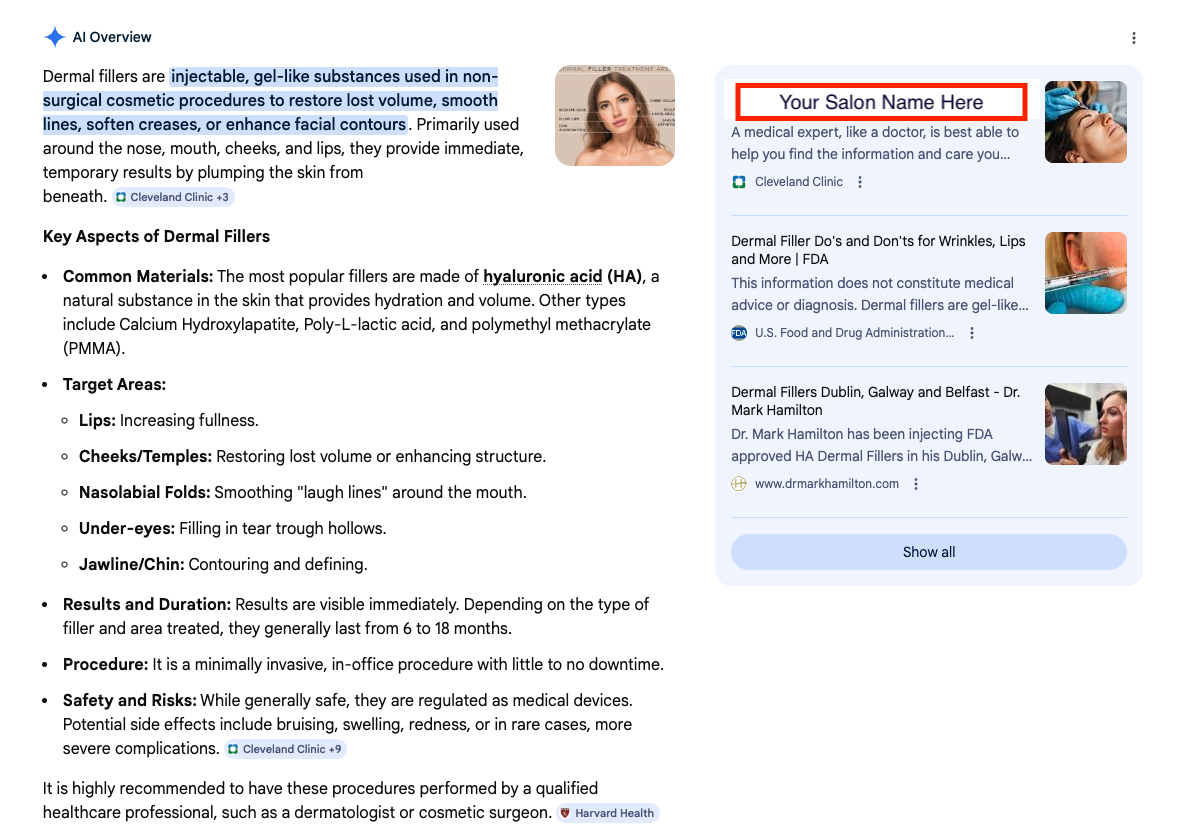
Google AI Overviews and SGE explained
When a user searches for a topic, Google's AI synthesises information from multiple trusted sources and presents a summary answer at the top of the results page. This is the generative search SEO (SGE, AI Overviews) environment. Clinics that appear as cited sources within these summaries gain visibility without the user needing to scroll to organic listings. Clinics that do not appear are effectively invisible to a growing proportion of search traffic.
Zero-click searches and the impact on clinics
A zero-click search healthcare outcome is one where the user finds their answer in the AI Overview and does not click through to any individual website. For informational queries — "how long do anti-wrinkle injections last?" or "what is the recovery time for dermal fillers?" — zero-click rates are high. The implication for clinics is not that organic traffic is worthless; it is that appearing in the AI-generated answer is the new first position, and achieving it requires a fundamentally different approach to aesthetic clinic SEO UK than keyword optimisation alone.
The shift from keywords to entities and intent
Traditional SEO was built around matching keywords. AI search optimisation for clinics is built around entities — named things that Google can recognise and verify: your clinic, your practitioners, your treatments, and your location. AI systems understand the relationships between these entities and use them to determine which sources are relevant, credible, and authoritative for a given query. A clinic that exists clearly as a verified entity in Google's knowledge graph has a structural advantage over one that exists only as a set of keyword-rich pages.
How AI Search Ranks Aesthetic Clinics
Understanding the AI search ranking factors for healthcare that determine which clinics appear in AI-generated answers is the starting point for any effective strategy. These factors are not entirely new — they extend and intensify principles that have always mattered in SEO — but their relative weight has shifted significantly.
Entity recognition
AI systems identify and rank entities — not just pages. Knowledge graph entities for clinic SEO is the term for the model Google builds of your clinic as an entity: its name, location, the treatments it offers, the practitioners who work there, and the relationships between all of these. The more consistently and clearly these entities are defined across your website, Google Business Profile, and third-party directories, the more confidently Google can recognise and feature your clinic.
E-E-A-T — Experience, Expertise, Authority, Trust
E-E-A-T healthcare SEO — Experience, Expertise, Authoritativeness, and Trustworthiness — is Google's quality framework for evaluating sources. For healthcare and medical content, Google applies a heightened standard recognising that inaccurate or misleading health information carries real-world risk. For aesthetic clinics, meeting this standard means demonstrating genuine practitioner expertise (qualifications, registrations, clinical experience), institutional authority (professional memberships, regulatory registrations), and trustworthiness (verified reviews, consistent NAP, transparent contact information).
Structured data and semantic relevance
Structured data for medical websites — schema markup — gives AI systems an unambiguous, machine-readable description of what your website contains. Rather than inferring from your content that you are a medical practice offering aesthetic treatments, schema tells Google directly. This reduces the risk of misclassification, strengthens entity recognition, and increases the probability of being cited in AI-generated answers.
Content quality over keyword density
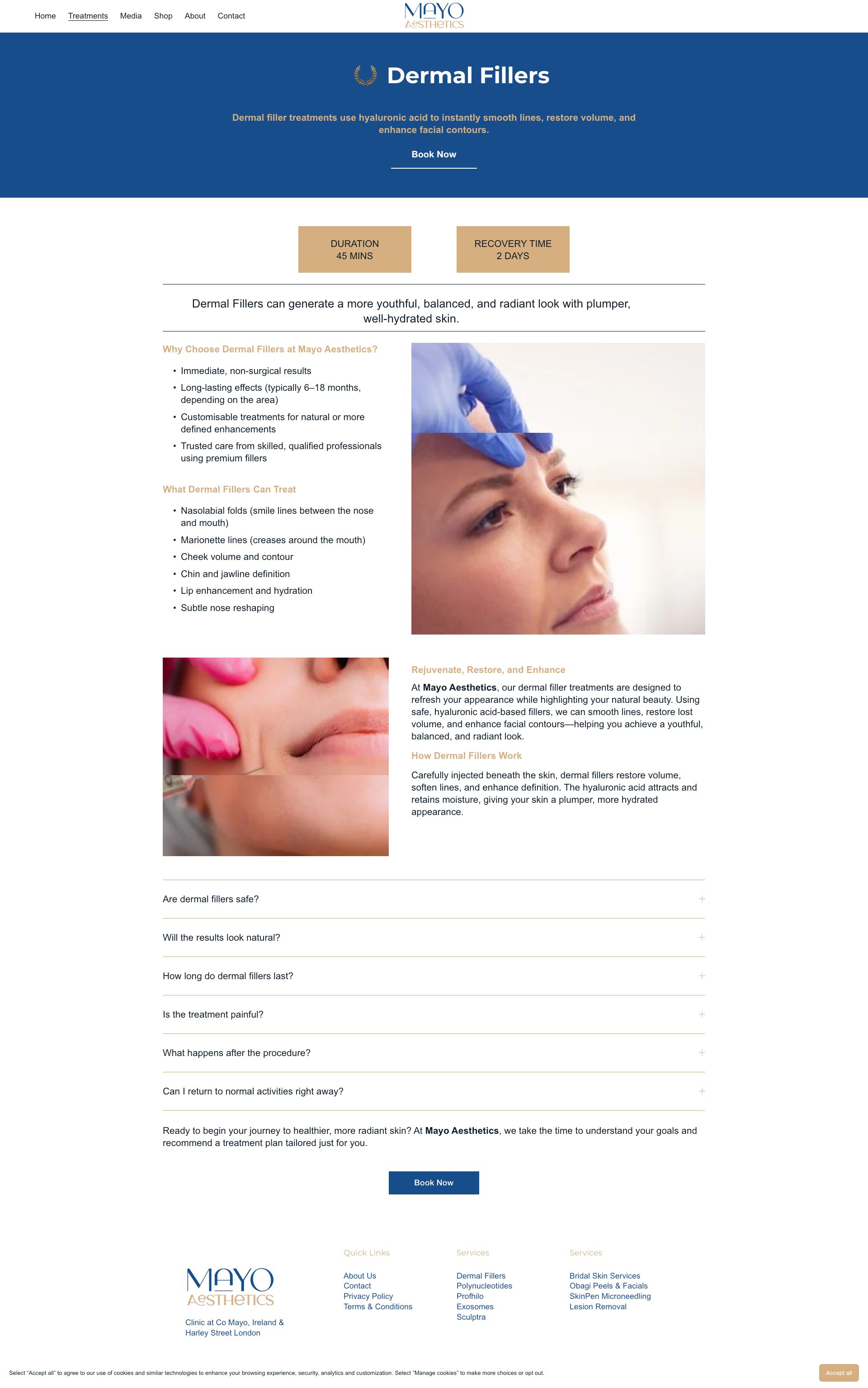
AI systems evaluate content for depth, accuracy, and genuine usefulness to the reader — not for keyword frequency. For semantic SEO for the aesthetic industry, this means writing treatment pages and blog content that comprehensively addresses the questions a prospective client has, in language that reflects how those questions are actually asked. A treatment page that covers indications, outcomes, risks, aftercare, and the clinical process will consistently outperform one that simply repeats a target keyword at regular intervals.
Build Strong Entity SEO for Your Clinic
Entity SEO for healthcare is the practice of making your clinic a clearly defined, consistently described, well-connected entity in Google's knowledge graph. It is the single most important structural investment a clinic can make in its AI search visibility, and it is largely invisible to clients — it happens in the architecture of your website and your broader online presence, not in the content they read.
Define your core entities
Every clinic has three primary entities to define: the clinic itself (name, address, phone, opening hours, services), the practitioner or practitioners (name, qualifications, registration body, specialisms), and the treatments offered (specific procedures, the concerns they address, the client groups they serve). Each of these entities should be described consistently and completely on your website. If your clinic name varies across your homepage, contact page, and Google Business Profile, Google cannot resolve these into a single confident entity.
Connect entities across the web
Entity authority is built not just on your own website but across the web. Your Google Business Profile optimisation for clinics, major healthcare and beauty directories (Treatwell, Doctify, What Clinic, Fresha), professional body listings (JCCP, Save Face, BABTAC), and any press or media coverage all contribute signals to Google's entity model. Each of these should use exactly the same clinic name, address, and phone number as your website. NAP (Name, Address, Phone) consistency is a foundational requirement for local search visibility.
| Entity SEO is not a tactic — it is a discipline. The clinic that AI features is the one Google can verify, not just the one that ranks for keywords. |
Create Topical Authority in Aesthetic Treatments
Topical authority for skincare clinics means owning a topic in Google's assessment — being recognised as a comprehensive, reliable source of information about a subject. For aesthetic clinics, topical authority is built treatment by treatment. A clinic that publishes a well-structured pillar page on anti-wrinkle injections, supported by blog content addressing the specific questions clients ask about that treatment, signals to Google that it has genuine depth of knowledge on the subject.
Cluster content strategy
The most effective approach to building topical authority for skincare clinics is a content cluster model. Each major treatment becomes a cluster: a pillar page covering the treatment comprehensively, with a series of supporting blog posts targeting the specific questions and concerns clients have. The pillar page and all supporting content link to each other, concentrating topical authority and creating a clear content hierarchy that AI systems can navigate.
Anti-wrinkle injections cluster: pillar page + supporting Q&A content on results, areas treated, and first appointments
Dermal fillers cluster: pillar page + supporting content on comparisons, pricing, and aftercare
Skin treatments cluster: pillar page + content on specific concerns, comparisons, and home care
Answering client intent questions
The blog content within each cluster should be driven by actual client questions, not by keyword tools alone. Content clusters for aesthetic clinics work because they demonstrate to AI that a clinic understands the full range of concerns a client has about a treatment — not just the high-volume search terms. Google's People Also Ask (PAA) feature, forums, and client consultation notes are all useful sources of genuine question data. Each blog post should answer one question clearly and completely, in language that mirrors how the question is asked.
Optimise Your Website for AI Understanding
Beyond content strategy, the technical structure of your website determines how easily AI systems can understand and use it. A well-structured website is not just better for AI search optimisation for clinics — it is better for every visitor, because clarity for machines and clarity for humans are the same thing.
Clear page structure
Every page should follow a clear heading hierarchy: one H1 that describes the page's primary topic, H2 headings for major sub-topics, and H3 headings for specific points within each sub-topic. This hierarchy gives AI systems a structured outline of the page's content before they process the full text. The heading structure should reflect how the topic is organised logically, not just how it needs to be formatted visually.
Internal linking between treatments
Internal links connect your entities to each other and signal their relationships to Google. A page about lip fillers should link to the main dermal fillers page, and both should link to the practitioner page. The anti-wrinkle injections page should cross-link to the consultation booking page. This web of connections builds site-wide topical authority and shows Google that pages are meaningfully related.
FAQ schema and structured data
Structured data for medical websites implementation should include the FAQPage schema on any page that contains question-and-answer content. This directly feeds Google's AI Overview system, which frequently sources answers from FAQ schema. The questions should match the language of real searches, and the answers should be complete, accurate, and concise.
Conversational content
Conversational search optimisation means writing content in the natural language patterns of how people ask questions, not in the formal register of marketing copy. AI systems are trained on conversational language and are better at parsing and citing content that reads naturally. For treatment pages and blog posts, this means writing in a tone that mirrors a knowledgeable practitioner explaining a treatment to a client — informative, specific, and direct — rather than the promotional language of an advertisement.
Local SEO Signals That Feed AI Search
AI search results are heavily localised. When someone searches for an aesthetic clinic, Google's AI understands that they want a nearby option — and the local signals your clinic sends determine whether you appear. Local SEO for cosmetic clinics is not a separate discipline from AI search optimisation; it is a core component of it.
Google Business Profile optimisation
Google Business Profile optimisation for clinics is the highest-priority local SEO action available to most aesthetic clinics. A complete and actively managed profile — with accurate NAP details, all treatment categories selected, opening hours current, photos updated regularly, and all reviews responded to — sends strong local authority signals to Google's AI. Incomplete or outdated profiles are deprioritised in local AI results.
Reviews, ratings, and engagement
Reviews are both a patient trust signals SEO factor and a direct local ranking signal. AI systems use review volume, recency, rating, and the content of reviews — the specific treatments mentioned, the outcomes described, the clinic's response — as data points in evaluating local relevance and authority. Systematically requesting reviews post-appointment and responding professionally to every review received, is one of the most commercially impactful activities an aesthetic clinic can invest in.
Location-based landing pages
For clinics serving multiple locations or drawing clients from a wider area, dedicated location landing pages strengthen local SEO for cosmetic clinics significantly. Each location page should be genuinely useful — clinic address and travel information, local context, and treatment content specific to that page's geo-keyword target — rather than a near-duplicate of other location pages with only the place name changed. Thin location pages produce no local ranking benefit.
Local citations — UK and Ireland directories
Local citations — mentions of your clinic's name, address, and phone number on third-party websites — contribute to clinic online visibility for UK and Ireland by reinforcing your entity's geographic and business identity. Priority citation sources for UK and Irish aesthetic clinics include Treatwell, Doctify, What Clinic, Fresha, Thomson Local, Yell, the Golden Pages (Ireland), and relevant professional body directories. Every citation should use identical NAP data to your website and Google Business Profile.
Build Trust Signals — E-E-A-T for Clinics
For AI systems evaluating which clinics to feature, E-E-A-T healthcare SEO is the overarching quality framework. Each of the four dimensions — Experience, Expertise, Authoritativeness, and Trustworthiness — maps directly onto actions a clinic can take to increase its AI visibility. These are not abstract quality scores; they are signals built from specific, verifiable content and connections.
Practitioner credentials and professional registration
The practitioner page is one of the most important patient trust signals SEO pages on a clinic website, and one of the most frequently underdeveloped. It should include full name, professional qualifications, registration body and number (GMC, NMC, or equivalent), membership of aesthetic professional bodies (JCCP, Save Face, BABTAC, BCAM), relevant training and CPD record, and years of clinical experience. In Ireland, HIQA registration where applicable. These details should also be reflected in schema markup as a Person entity.
Real client reviews
Verified reviews from Google Business Profile, Trustpilot, or Doctify carry far more weight as patient trust signals SEO than testimonials on the clinic's own website, because they are perceived as independent. Review content matters as well as volume: reviews that mention specific treatments, describe outcomes, and reference the practitioner by name provide richer entity signal data. Responding to all reviews promptly and professionally reinforces authority and engagement signals.
Before-and-after content — compliant usage
Before-and-after images are powerful trust signals, but they are also one of the most regulated content types in aesthetic marketing. All images must comply with ASA (UK) and ASAI (Ireland) advertising standards: consistent photography conditions, no misleading post-processing, written client consent obtained and retained, and clear disclaimers that results are individual and not guaranteed. Compliant before-and-after content builds trust; non-compliant content creates regulatory risk and, if the subject of an ASA ruling, actively harms the clinic's credibility.
Media mentions and backlinks
Backlinks from authoritative third-party websites — press coverage, professional body listings, trade publication features — contribute directly to E-E-A-T healthcare SEO by demonstrating that your clinic is recognised by sources that Google already trusts. Priority backlink sources include Aesthetic Medicine, Professional Beauty, JCCP, Save Face, local press, and health and wellness publishers. Each mention of the clinic's name alongside its treatments and location also strengthens entity recognition.
Content That Gets Featured in AI Answers
Not all content is equally likely to appear in Google AI search results ranking summaries. AI systems have discernible preferences for the type, format, and tone of content they cite. Understanding these preferences and structuring content accordingly is one of the most direct levers available for improving AI search optimisation for clinics.
FAQ-style content and PAA optimisation
Google's People Also Ask (PAA) feature is a direct window into the questions that AI systems are primed to answer. Each question in PAA for a given topic represents an opportunity: publish a clear, concise, accurate answer to that question, structured with the question as a heading and the answer as the immediately following paragraph. Conversational search optimisation for AI means matching this format precisely. The answer should be complete in two to four sentences — long enough to be useful, short enough to be featured.
Clear, concise answers
AI Overviews consistently favour content that answers a question directly and without preamble. For generative search SEO (SGE, AI Overviews), the ideal structure is: question as heading, direct answer in the first sentence, supporting detail in the following two to three sentences. Content that buries the answer in background information, or that hedges excessively before stating a position, is consistently passed over in favour of more direct sources.
Evidence-based claims — ASA compliant
AI systems are trained to prefer factual, evidence-based content over promotional claims. This directly aligns with aesthetic clinic SEO UK compliance requirements: the ASA requires that claims be truthful and substantiated, and non-compliant promotional language is precisely the type of content AI systems deprioritise. Writing accurate, evidence-based content is both the compliant approach and the strategically correct one.
Educational versus promotional tone
The distinction between educational and promotional content is not just a compliance consideration — it is an AI search ranking factors for healthcare factor. AI systems are built to surface useful information, not advertising. Content that explains how a treatment works, what to expect, who is a good candidate, and what the risks are will consistently outperform content that simply promotes the treatment. The goal is to be the most informative source on a topic, not the most enthusiastic one.
Structured Data & Schema for Clinics
Structured data for medical websites implementation is one of the highest-impact technical actions available to an aesthetic clinic. Schema markup does not directly guarantee AI citation, but it substantially increases the probability by providing AI systems with unambiguous, machine-readable information about the clinic's identity, services, location, and quality signals.
| Schema type | Where to apply | What it tells AI |
|---|---|---|
| MedicalBusiness | Homepage + location pages | Name, address, phone, opening hours, services, geo-coordinates |
| LocalBusiness | Homepage | Supports MedicalBusiness; adds payment methods, price range, area served |
| FAQPage | Treatment pages, FAQ page | Question-and-answer pairs that feed directly into AI Overviews |
| Review / AggregateRating | Homepage, treatment pages | Star rating and review count, sourced from verified platforms |
| MedicalProcedure | Individual treatment pages | Procedure name, body location, how performed, preparation |
| Person | Practitioner / about page | Name, job title, credentials, affiliated organisation |
Schema should be implemented in JSON-LD format, placed in the page's <head> section. Each schema type should be fully populated — partial schema with missing required fields is less effective than no schema at all. The combination of MedicalBusiness, FAQPage, and Review schema on a treatment page provides one of the strongest structured data signals available to a clinic.
Example Schema
Homepage
{
  "@context": "https://schema.org",
  "@type": "MedicalBusiness",
  "name": "Riverside Aesthetic Clinic",
  "address": {
    "@type": "PostalAddress",
    "streetAddress": "12 Bridge Street",
    "addressLocality": "Dublin",
    "postalCode": "D02 XY45",
    "addressCountry": "IE"
  },
  "telephone": "+353-1-555-0100",
  "geo": { "@type": "GeoCoordinates", "latitude": 53.3498, "longitude": -6.2603 },
  "openingHours": "Mo-Fr 09:00-18:00",
  "medicalSpecialty": "Cosmetic",
  "priceRange": "€€"
}
Practitioner Qualifications
{
  "@context": "https://schema.org",
  "@type": "Person",
  "name": "Dr. Aoife Byrne",
  "jobTitle": "Aesthetic Practitioner",
  "worksFor": { "@type": "MedicalBusiness", "name": "Riverside Aesthetic Clinic" },
  "alumniOf": "Royal College of Surgeons in Ireland",
  "memberOf": ["JCCP", "BCAM"],
  "hasCredential": {
    "@type": "EducationalOccupationalCredential",
    "credentialCategory": "NMC Registration",
    "identifier": "12A345B"
  }
}
Treatment page ‘Dermal Fillers”
{
  "@context": "https://schema.org",
  "@type": "MedicalProcedure",
  "name": "Dermal Fillers",
  "procedureType": "http://schema.org/NoninvasiveProcedure",
  "bodyLocation": "Face",
  "howPerformed": "Hyaluronic acid gel injected beneath the skin to restore volume and smooth lines, performed by a qualified practitioner following consultation.",
  "preparation": "Avoid blood-thinning medication and alcohol for 24 hours before treatment; arrive with a clean, makeup-free face.",
  "followup": "Avoid strenuous exercise, sun exposure and alcohol for 24-48 hours; results typically last 6-12 months.",
  "provider": {
    "@type": "MedicalBusiness",
    "name": "Riverside Aesthetic Clinic"
  }
}
Voice Search & Conversational SEO
Voice search optimisation for clinics is increasingly inseparable from AI search optimisation. Voice queries are inherently conversational — they are phrased as complete questions rather than keyword strings — and the AI systems that power voice search assistants draw from the same pool of authoritative, well-structured content as Google's AI Overviews. Optimising for voice search and optimising for AI search are, in most practical respects, the same activity.
Optimising for conversational questions
The queries that voice search and AI systems are most frequently asked about aesthetic clinics are highly conversational: "Where can I get anti-wrinkle injections near me?", "What is the best treatment for fine lines?", "How much do dermal fillers cost in Dublin?". Conversational SEO means creating content that matches this phrasing — publishing FAQ content that addresses these specific questions in natural, direct language that AI systems prefer to cite.
Long-tail conversational keywords
Long-tail queries — specific, multi-word questions — are the primary traffic driver for voice search optimisation for clinics and increasingly for AI Overviews. A clinic that publishes comprehensive answers to highly specific client questions captures intent at the precise moment it is formed, with content that AI systems are well-positioned to feature.
Mobile-first optimisation
The majority of voice searches and AI-assisted queries happen on mobile devices. Aesthetic clinic SEO UK for AI search requires the same mobile performance standards as traditional SEO: fast loading speeds (Core Web Vitals compliance), mobile-responsive layouts, and accessible navigation on small screens. A technically poor mobile experience undermines every other AI search optimisation investment.
Compliance Considerations (UK & Ireland)
Compliance is not a constraint on AI search optimisation for clinics — it is a component of it. AI systems are trained to surface trustworthy, accurate content. Non-compliant promotional language, misleading claims, and undisclosed advertising are precisely the types of content AI systems are designed to deprioritise. For clinic online visibility for UK and Ireland, meeting ASA (UK) and ASAI (Ireland) standards is both a legal requirement and an AI search strategy.
ASA & CAP Code (UK)
UK advertising law requires that all marketing content — including website pages, blog posts, and social media — is truthful, substantiated, and not misleading. For injectable treatments, the prescription-only medicine (POM) advertising restriction prohibits direct consumer promotion of the specific medicine by name. Clinics should frame content around the concern being addressed and the consultation process rather than the injectable itself. All efficacy claims must be hedged appropriately, before-and-after imagery must comply with ASA standards, and any claim that could be interpreted as a guarantee of outcome must be avoided.
ASAI Guidelines (Ireland)
The ASAI framework applies the same core principles — truthful, non-exaggerated, non-misleading marketing — with some variation in enforcement approach. For clinic online visibility for UK and Ireland, clinics operating across both markets should apply the stricter of the two standards where they differ, which in practice means following ASA/CAP Code standards as the baseline. GDPR obligations apply in both jurisdictions.
| COMPLIANCE NOTE | This article provides general guidance on advertising and SEO compliance for aesthetic clinics. It is not legal advice. For specific compliance queries, consult a qualified advertising law solicitor or contact the CAP Copy Advice team directly. |
Common Mistakes Preventing Clinics from Appearing in AI Search
The AI search ranking factors for healthcare that determine whether a clinic appears in AI-generated answers are well-understood — but so are the mistakes that prevent many clinics from meeting them. The table below covers the most common errors and why each creates an AI visibility problem.
| Mistake | Why it prevents AI visibility |
|---|---|
| Thin or duplicate content | Pages with little unique value are ignored by AI systems, which prioritise depth and authority. |
| No entity consistency | If your clinic name, address, or practitioner name varies across your website, Google Business Profile, and directories, AI cannot confidently identify your entity. |
| Missing trust signals | No credentials displayed, no reviews, no professional memberships — AI systems deprioritise sources they cannot verify. |
| Promotional language | Content that reads as advertising rather than information is less likely to be cited by AI. Compliance with ASA/ASAI is also a legal requirement. |
| Neglecting local SEO | AI search results are heavily localised. Without a complete Google Business Profile and consistent local citations, you are invisible to clients searching nearby. |
| No schema markup | Structured data is one of the clearest signals you can send to AI systems. Omitting it means relying entirely on AI to infer what your site is about. |
Step-by-Step Strategy to Rank in AI Search
Understanding what works is one side of the AI search equation. Equally important is understanding the common mistakes that prevent many clinics from appearing, regardless of the quality of their content.
| Step | Action | What to do |
|---|---|---|
| 1 | Optimise Google Business Profile | Complete every field, add treatment categories, post regular updates, and respond to all reviews promptly. |
| 2 | Build entity-rich website structure | Define your clinic, practitioner, and treatment entities. Ensure consistent naming across all pages and external profiles. |
| 3 | Publish topical authority content | Create pillar pages per treatment with supporting blog content. Answer the questions your prospective clients are actually asking. |
| 4 | Add schema markup | Implement MedicalBusiness, FAQ, Review, and Location schema. Give AI systems structured, unambiguous data about your clinic. |
| 5 | Earn reviews and backlinks | Systematically request reviews post-appointment. Seek backlinks from local directories, industry associations, and press mentions. |
| 6 | Maintain compliance | Ensure all content meets ASA (UK) and ASAI (Ireland) standards. Non-compliant content undermines trust signals and risks adjudication. |
The following strategy consolidates the elements covered in this guide into a prioritised action plan. Each step builds on the previous ones: a well-optimised Google Business Profile amplifies the effect of a well-structured website, which amplifies the effect of quality content, which amplifies the effect of schema markup. In AI search, the whole is genuinely greater than the sum of its parts.
| The clinics that appear in AI search results are not the ones that optimised once — they are the ones that keep showing up, keep publishing, and keep earning trust. |
Ten steps. One system. Get your clinic cited in Google's AI answers — download the free implementation checklist
Frequently Asked Questions
-
Generative search SEO (SGE, AI Overviews) describes AI-generated summaries that appear at the top of Google's results page, synthesising information from multiple sources to answer a query directly. They are produced by Google's Gemini AI model, which evaluates content for relevance, authority, and trustworthiness before deciding what to cite. For aesthetic clinics, appearing in these summaries means your content is being used as a source, which is why content quality and entity clarity are now more important than keyword density.
-
Focus on the core AI search optimisation for clinics factors: define your clinic as a clear entity with consistent NAP across all platforms, build topical authority through content clusters, implement schema markup, maintain a complete and active Google Business Profile, earn and respond to reviews, and ensure all content is compliant and evidence-based. There is no single shortcut, as AI visibility is built from the aggregate strength of all these signals working together.
-
E-E-A-T healthcare SEO stands for Experience, Expertise, Authoritativeness, and Trustworthiness. It is Google's quality evaluation framework, applied with heightened standards to health and medical content. For aesthetic clinics, E-E-A-T means demonstrating that treatments are performed by qualified practitioners, that the clinic has genuine clinical experience, that it is recognised by professional bodies, and that its information is accurate, transparent, and verifiable.
-
Yes, reviews are a significant patient trust signals SEO input into Google AI search results ranking. Review volume, recency, average rating, and the content of reviews all contribute to how Google's AI assesses the trustworthiness and local authority of a clinic. Responding to reviews signals active engagement. For maximum impact, reviews should be consistently requested post-appointment across Google Business Profile and relevant third-party platforms.
-
Structured data for medical websites implementation is highly important for AI search optimisation for clinics. Schema markup provides AI systems with structured, unambiguous information about the clinic, including its name, location, services, practitioners, and quality indicators, without requiring the AI to infer these from content. MedicalBusiness, FAQPage, Review, and Person schema together create a comprehensive machine-readable profile that significantly increases the probability of appearing in AI-generated answers.
-
It is significantly harder. Topical authority for skincare clinics is built through the depth and breadth of content covering a topic, which requires more than static treatment pages alone. Without a blog or content hub, a clinic cannot build the content clusters that demonstrate topical authority, cannot capture long-tail question queries, and cannot create the volume of FAQ schema that feeds directly into AI Overviews. A modest but consistent content programme is one of the highest-return SEO investments available.
-
Content that is clear, direct, evidence-based, and structured around real questions. Generative search SEO (SGE, AI Overviews) consistently favours FAQ-format content where a question is posed as a heading and answered concisely in the following paragraph, content that is compliant and does not make unsubstantiated claims, content from sources that demonstrate E-E-A-T signals, and content with FAQ schema markup that gives Google structured data to work from directly.
-
This is not a one-time exercise. Google AI search results ranking for aesthetic clinics is dynamic; Google's AI systems update continuously, and the clinics that maintain their visibility are those that treat SEO as an ongoing programme rather than a launch-week activity. Consistently publishing new content, maintaining review volume, keeping schema current, and monitoring compliance are the habits that compound into sustained visibility over time.
Want your clinic to appear where clients are searching?
Websites for Clinics builds AI-search-ready websites for aesthetic clinics across Ireland and the UK — with built-in entity SEO, schema markup, and compliant content written specifically for the aesthetic sector. To find out more about how we can help you design and build a website, read our page Website Design For Aesthetic Clinics